All Fired Up

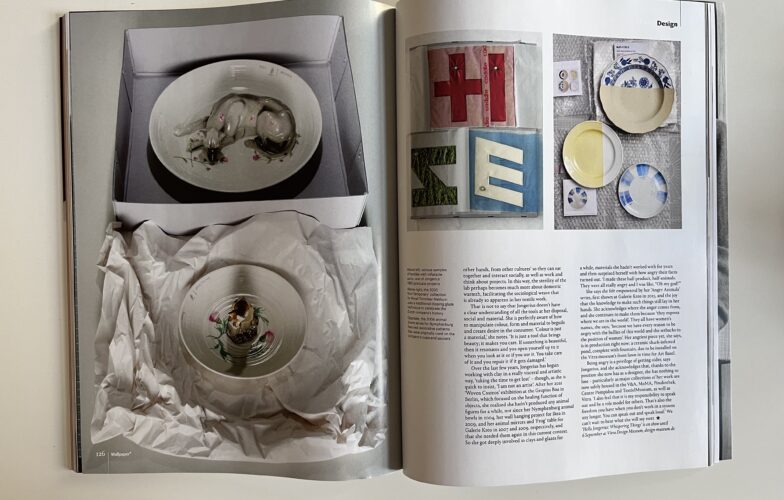
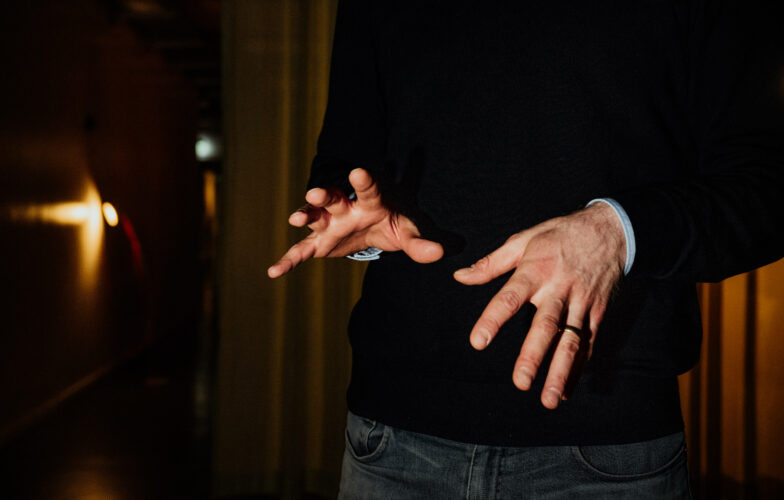
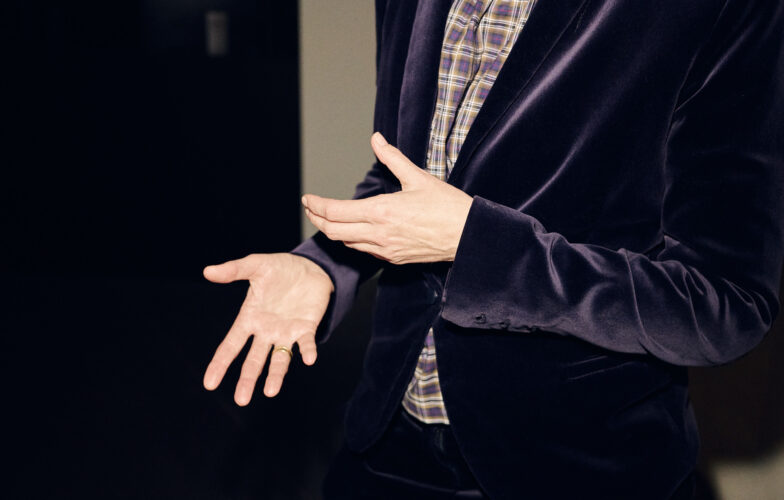
An interview with Hella Jongerius

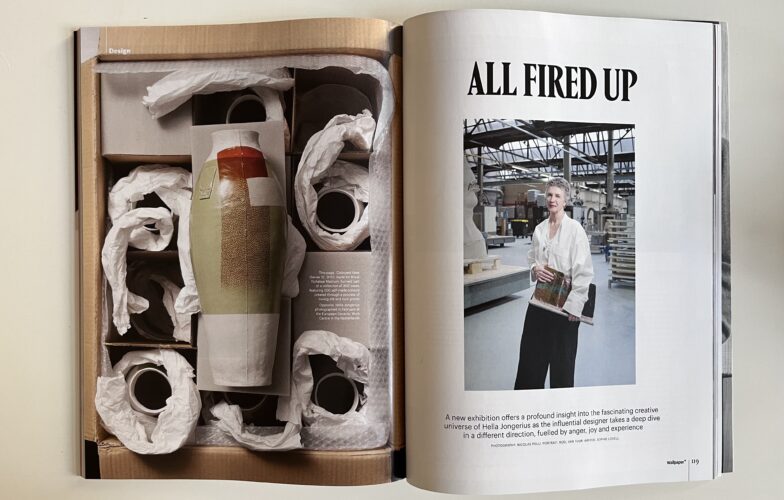
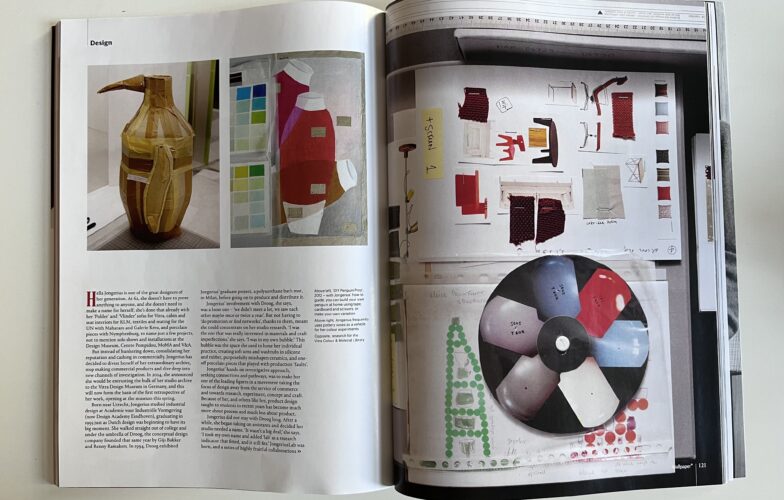
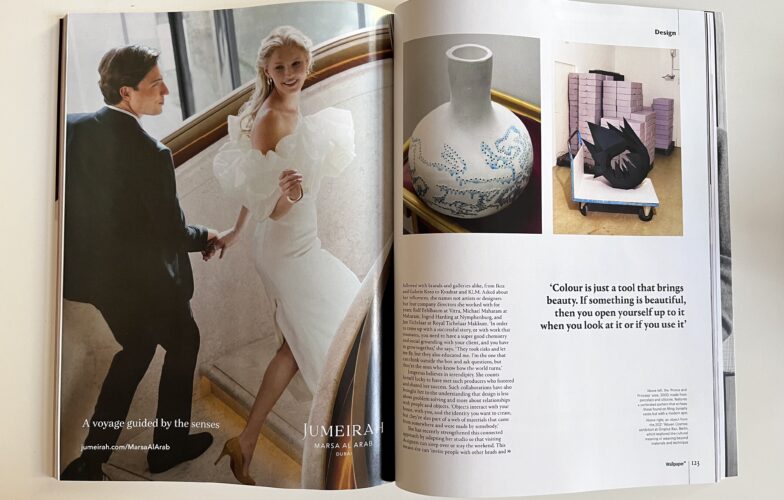
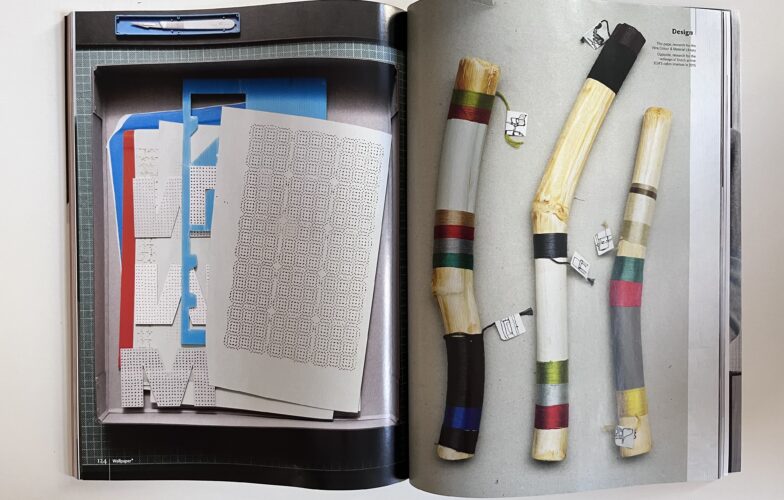
“Jongerius’ hands-on investigative approach, seeking connections and pathways, was to make her one of the leading figures in a movement taking the focus of design away from the service of commerce and towards research, experiment, concept and craft. Because of her, and others like her, product design taught to students in recent years has become…

+ Full text and information

“Jongerius’ hands-on investigative approach, seeking connections and pathways, was to make her one of the leading figures in a movement taking the focus of design away from the service of commerce and towards research, experiment, concept and craft. Because of her, and others like her, product design taught to students in recent years has become much more about process and much less about product.”

Read the full article here.

Revisit Checkpoint Charlie

Sophie Lovell for The Architectural Review

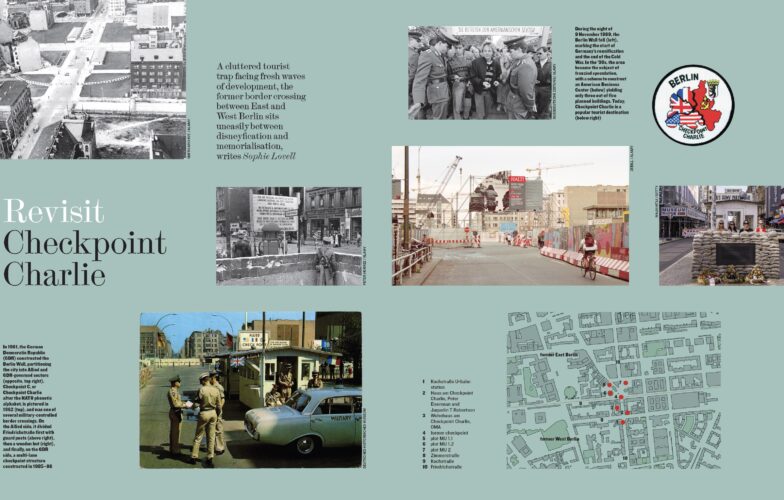
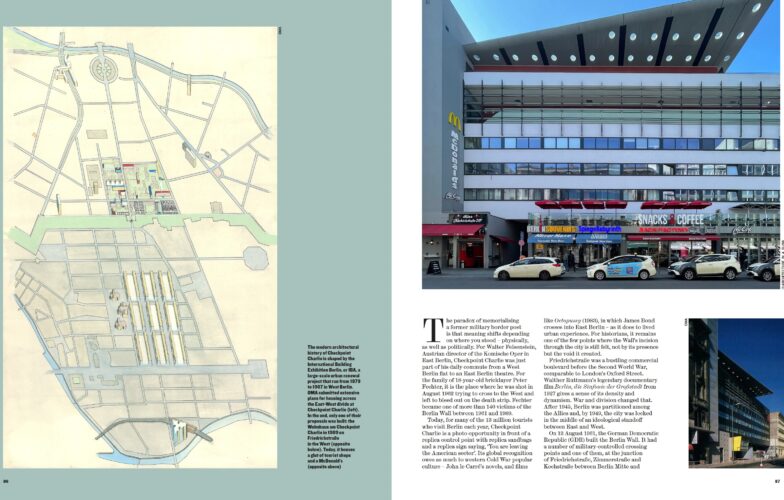
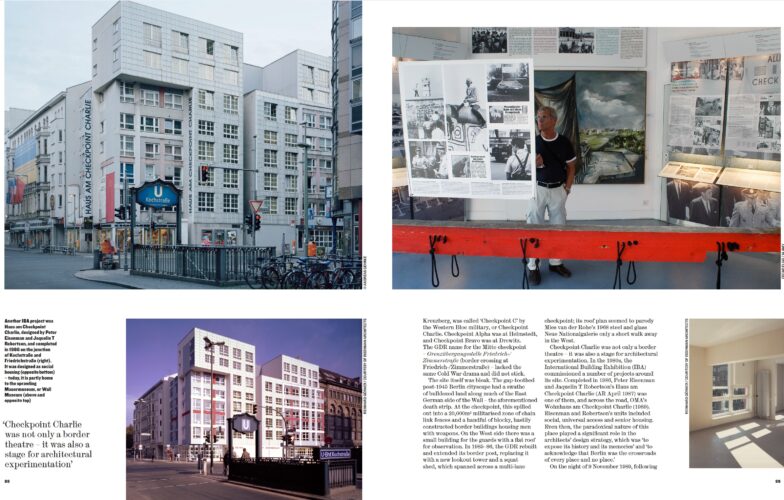
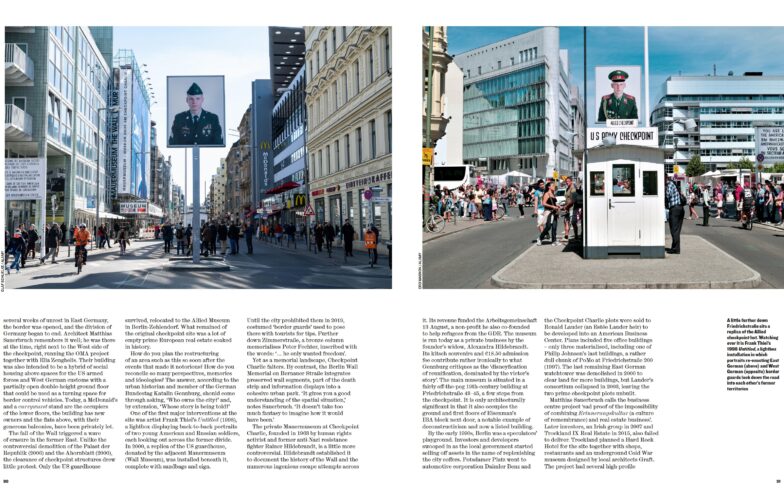
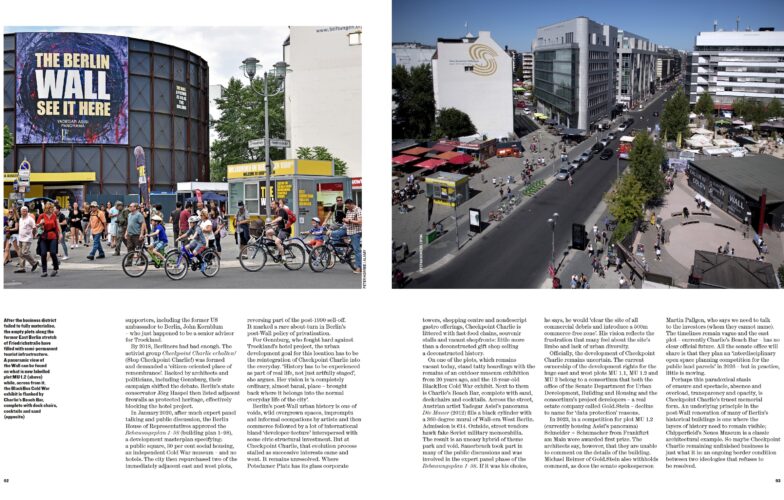
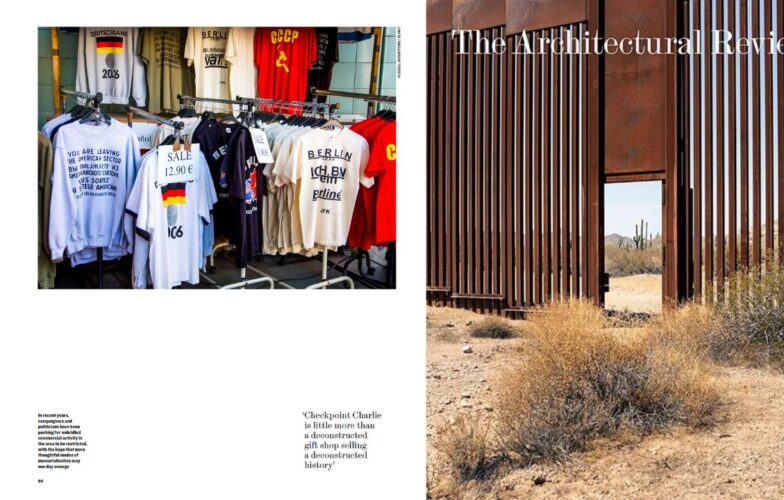
“Where Potsdamer Platz has its glass corporate towers, shopping centre and nondescript gastro offerings, Checkpoint Charlie is littered with fast‑food chains, souvenir stalls and vacant shopfronts: little more than a deconstructed gift shop selling a deconstructed history.”

+ Full text and information

“Where Potsdamer Platz has its glass corporate towers, shopping centre and nondescript gastro offerings, Checkpoint Charlie is littered with fast‑food chains, souvenir stalls and vacant shopfronts: little more than a deconstructed gift shop selling a deconstructed history.”

Sophie Lovell revisited Checkpoint Charlie in her hometown of Berlin for the “Borders” issue of the Architectural Review. Now a cluttered tourist trap facing fresh waves of development, the former border crossing between East and West Berlin sits uneasily between disneyfication and memorialisation – always becoming, never being.

Article link here.

Revisit Schlangenbader Straße

Sophie Lovell for The Architectural Review

“45 years after completion, this crazy superstructure works because it is modest by design and because it has been continuously cared for. It’s Big Housing meeting Big Car without a pile up because its architects did their research; because they believed their primary social responsibility towards quality of life; and because their clients continue to carry that through.”

+ Full text and information

“45 years after completion, this crazy superstructure works because it is modest by design and because it has been continuously cared for. It’s Big Housing meeting Big Car without a pile up because its architects did their research; because they believed their primary social responsibility towards quality of life; and because their clients continue to carry that through.”

I wrote about the Schlangenbader Straße Estate in Berlin for June 2025 “Roads” issue of The Architectural Review  The “Schlange” (snake), as locals call it, is a late 1970s superstructural landscape by Georg Heinrichs, Gerhard Krebs and Klaus Krebs, with a motorway running through it that is not as well-known as it probably should be. With new photography by the excellent Felix Koch.

Article link here.

S72+ TOMAS

"Burned Out & Empty"

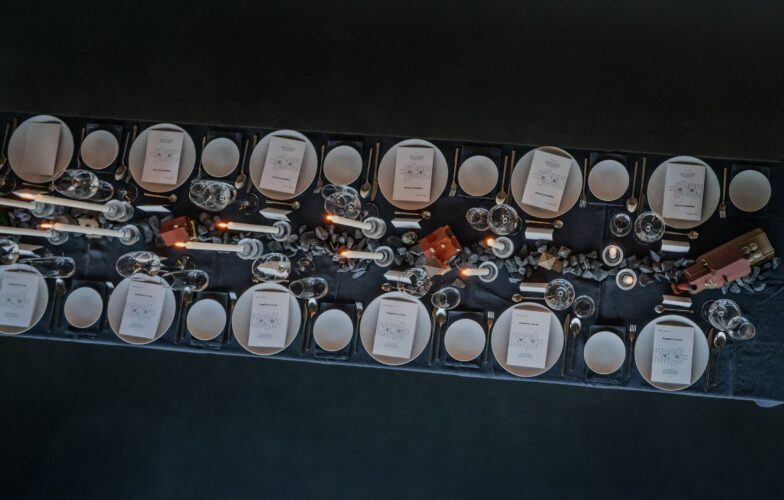
Our 5th S72+ dinner was on our home turf of Berlin, together with the socially responsible architectural enterprise TOMAS, transformation of material and space. The theme “Burned Out  & Empty” was an invitation to discuss ideas on repurposing built space and sustainable construction in Berlin at a time of acute housing shortages and no environmental…

+ Full text and information

Our 5th S72+ dinner was on our home turf of Berlin, together with the socially responsible architectural enterprise TOMAS, transformation of material and space. The theme “Burned Out  & Empty” was an invitation to discuss ideas on repurposing built space and sustainable construction in Berlin at a time of acute housing shortages and no environmental budget left to build new. The next stage of Berlin’s built future needs to be radically different. Our guests were Regula Lüscher, former Senate Building Director and State Secretary for urban Development and Housing in Berlin; Dag Ortkrass, Managing Partner at Diete+Siepmann Ingenieurgesellschaft; Thomas Beyerle, Professor of Real Estate Economics and Real Estate Research; Andreas Krüger, Managing Director of Belius GmbH; Lena Brühne, Managing Director of Art-Invest Real Estate Management; Olga Graf, food activist and Managing Director of Markthalle Neun in Berlin; and Hannes Bäuerle, Managing Director of Materialbank.

“The financial market wants maximum security and predictability, and building reactivation doesn’t offer that. But if sustainability and innovation were the yardstick for investment strategies, then that would change too.” – Regula Lüscher

“Space activation must be considered holistically and with a view to the future. This means: conversion instead of new construction, reusing materials, incorporating local ecosystems.” – Dag Ortkrass

“In times when society is becoming more and more divided, places and spaces for encounters and interaction are needed. Places where people, who might otherwise not come into contact, can interact. I also believe that such innovative initiatives should be owned by the city.” – Olga Graf

Our chef: Jonas Merold, our sponsors: Materialbank and Rosenthal, our photographer: Friedrich J Richter, our location: a temporary space in Mollstrasse 1, Berlin, which was originally built to house the GDR National News Service ADN.

The Severance Furniture Controversy (that *should* be?)

Sophie Lovell for For Scale

The functionalist design philosophy of Dieter Rams and his colleagues in the 1960s was a direct response to the dark horrors of totalitarianism and fascism. It grew out of a strong belief in designing a more democratic, more egalitarian world within, full of light and labour-saving devices for ‘users’ (not ‘consumers’) – products that gave…

+ Full text and information

The functionalist design philosophy of Dieter Rams and his colleagues in the 1960s was a direct response to the dark horrors of totalitarianism and fascism. It grew out of a strong belief in designing a more democratic, more egalitarian world within, full of light and labour-saving devices for ‘users’ (not ‘consumers’) – products that gave people the freedom of choice in the interiors of their homes to complement the rise of democracy without.

Read Sophie’s opinion piece on the (mis)use of Dieter Rams’ designs as signifiers in the TV series “Severance” here.

Teaching Food Thinking

Hotelschool The Hague

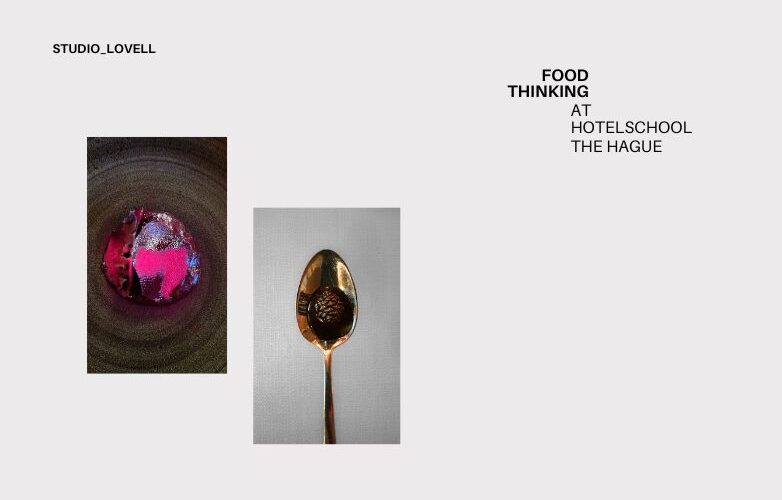
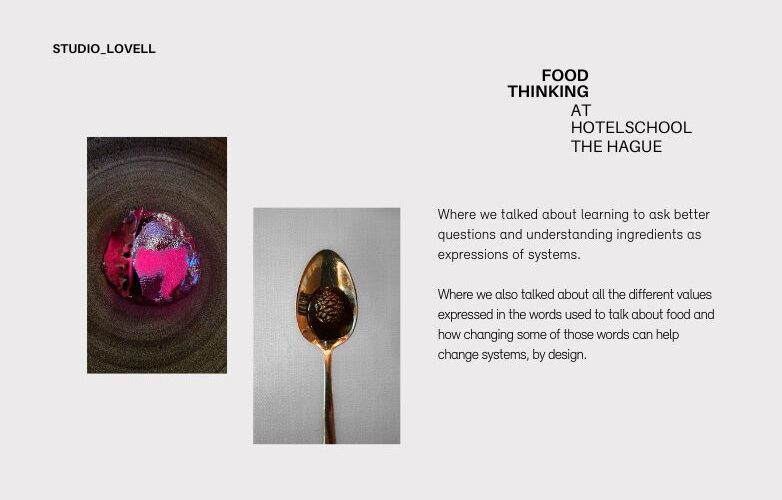
studio_lovell was invited to co-design an immersive dining experience and give a keynote talk at the Hotelschool The Hague for their Future of Food course in Amsterdam. We talked about learning to ask better questions and understanding ingredients as expressions of systems. And about all the different values expressed in the words used to talk about food…

+ Full text and information

studio_lovell was invited to co-design an immersive dining experience and give a keynote talk at the Hotelschool The Hague for their Future of Food course in Amsterdam. We talked about learning to ask better questions and understanding ingredients as expressions of systems. And about all the different values expressed in the words used to talk about food and how changing some of those words can help change systems, by design. And we collaborated with tutors Joost de Vos and Robert Gallicano to develop a series of dishes in the multi-course dinner revolving around rocks and minerals – from cooking and baking with stones and edible clays to using pebbles as flavour vehicles and metaphors. We also talked about learning to ask better questions and understanding ingredients as expressions of systems. And about all the different values expressed in the words used to talk about food and how changing some of those words can help change systems, by design.

S72+ Poggenpohl

"New Standards of Luxury"

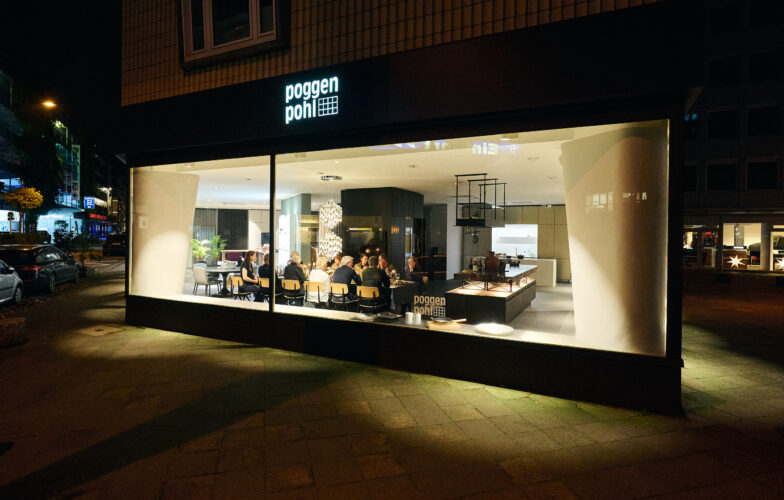
The S72+ dinners are collaborations between studio_lovell and like-minded partners with guests chosen from various disciplines. Our aim is to encourage knowledge exchange and expand the conversation around the table over shared food. We co-hosted this iteration with  Poggenpohl, curating three dinners in three locations: Hamburg, Düsseldorf and Stuttgart. Our topic of conversation was “New Standards…

+ Full text and information

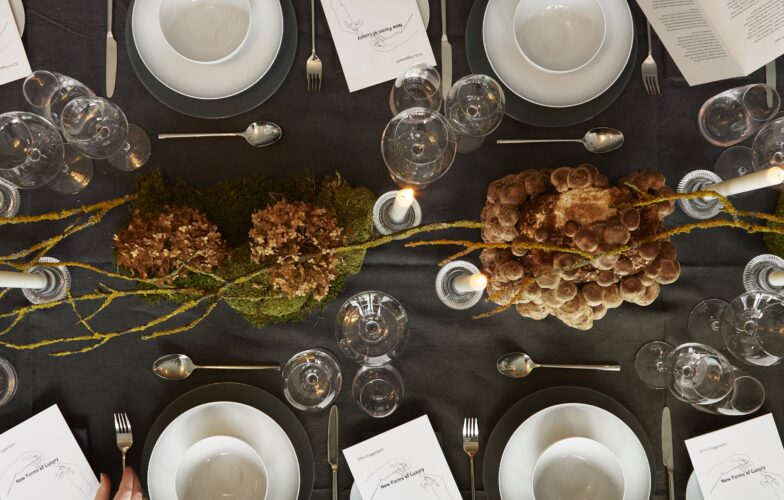
The S72+ dinners are collaborations between studio_lovell and like-minded partners with guests chosen from various disciplines. Our aim is to encourage knowledge exchange and expand the conversation around the table over shared food. We co-hosted this iteration with  Poggenpohl, curating three dinners in three locations: Hamburg, Düsseldorf and Stuttgart. Our topic of conversation was “New Standards of Luxury”. Our chef was Jonas Merold. And our guests were leading figures from the fields of furniture design, furniture fairs, porcelain manufacture, fashion, product design, experimental engineering, museum direction, wine-making, luxury brand marketing and more. 72 hours after each S72+ dinner (the time it takes to fully digest a meal), we ask our guests what they took home from the conversation.

“To me sensuality is a luxury. In a fast time, it can be a challenge to connect to your senses and engage in critical thinking. But I believe this is what our time needs from us.” – guest Melchior Grau, co-director of Grau

“Luxury is in the moments that take you beyond the everyday. Everyone is driven by something different and tries to shape the world in their own way. Only encounters beyond the everyday can make you realise how diverse life can be.” – guest Jan Knippers, Director of the ITKE

Luxury is giving a project time to mature – an almost impossible option in any industry. Luxury is also being able to buy something again and again.” – guest Insa Doan, Art Director at Rosenthal

See more guest quotes at studio_lovell’s Instagram and Instagram stories.

Photos © Jordana Schramm, Daniela Meise, Marko Seifert

Table service courtesy of Rosenthal

Redefining “Iconic” Architecture and Ideals

Sophie Lovell for Untapped Journal

“The word “iconic” is representative of a toxic, destructive paradigm. It belongs to a mindset of dominance over people and nature, where humankind is perceived to be discrete from nature, not part of it, and where some people are more equal than others.” Read the full article here.  

+ Full text and information

“The word “iconic” is representative of a toxic, destructive paradigm. It belongs to a mindset of dominance over people and nature, where humankind is perceived to be discrete from nature, not part of it, and where some people are more equal than others.”

Read the full article here.


Dieter Rams: As Little Design As Possible, 10th edition

By Sophie Lovell

“Indifference towards people and the reality in which they live is actually the one and only cardinal sin in design”

Dieter Rams

Sophie Lovell’s comprehensive monograph on the highly influential product designer Dieter Rams, Head of Design at Braun 1961-95 and designer of Vitsœ furniture systems.

First published in 2011, the 2024 10th edition has a new cover design and an updated introduction & timeline.

Foreword by Jonathan Ive.

+ Full text and information

“Indifference towards people and the reality in which they live is actually the one and only cardinal sin in design”

Dieter Rams

During the early stages of working on this book, I travelled to Osaka, Japan, for an exhibition about the work of Dieter Rams in the context of twentieth-century design. On the evening after the opening, we were sitting in a bar at the top of a high-rise hotel, looking out through huge plate-glass windows at the nocturnal panorama of the dense industrial Osaka cityscape. It had been a long day of press conferences, opening speeches and seminars followed by a Japanese banquet in Dieter Rams’s honour, and now I was in the company of a small group of people including Klaus Klemp, the exhibition’s co-curator, Mark Adams and Daniel Nelson from Vitsœ, Dieter Rams and his wife Ingeborg, and Rams’s good friend and advisor Britte Siepenkothen, enjoying a nightcap of Japanese whisky.

We were quietly discussing the day’s events when Dieter Rams, who had worked hard all day and appeared tired, suddenly said, ‘Why on earth do we need another book about me?’ At the age of seventy-six, Rams had been famous as a designer since he was twenty-five and despite acknowledging that having people interested in your work and ideas is no bad thing, he hated all the limelight and media attention. ‘I want nothing to do with this star designer machine,’ he added, suddenly getting rather worked up. We all looked at him. Apart from the fact that, as one of the most respected industrial designers in the world, he was a ‘star’ whether he liked it or not, the reason why the world needed another book had been made absolutely clear earlier in the day in the huge auditorium packed with young designers and design students hanging on to Rams’s every word. A particularly beautiful and precise speech at the symposium by the Japanese designer Naoto Fukasawa, who praised Rams’s oeuvre of what he aptly called ’correct design’, highlighted the level of respect there is for his work among today’s top professionals in the field. Klaus Klemp was the first to speak up: ‘Dieter,’ he said, ‘you still have work to do – to communicate and bring your message across to the young people.’ There was a chorus of assent from all those present.

Mollified, Rams agreed that this was a good reason to do another book. ‘But,’ he added, looking at me very intently, ‘it should be an empty book that says something important.’ In this respect, I have perhaps failed in my task. How do you write an empty book about someone whose working life has covered more than half a century and who has designed well over 500 products, and at the same time transmit all the complex interrelationships and contexts in which these products came into being? It would all be much simpler if one could state that Dieter Rams’s work and principles arose from him alone. But Rams would be the first to say that what constitutes his ‘work’ as an industrial designer is inseparable from the systems and networks through which it was produced. As such, assigning individual authorship to his work is, to some extent, meaningless. He could never have resolved his concepts without the ideas of his predecessors and his contemporaries, in what was an extraordinary era of worldwide growth and change. He could not have produced the things he did without the other designers at Braun, nor without the technicians, the managers, the materials manufacturers, the vision of the company’s original owners and even the marketing department. The same goes for his furniture design with Vitsœ, albeit on a smaller scale. Even beyond this vast network of people required to create his products, the designs themselves were modular and thus system-related. In nearly every instance, there are complex interrelationships within and between his designs: the improvements of individual components, how the products work with one another, how they are related aesthetically and in terms of intent, and how they function in the home. Last but not least, Rams’s products – in fact, his whole attitude and his principles – are geared towards the end user: they have to fit into the social systems, the lives and homes of a multitude of different kinds of people, and serve all of them discretely, reliably and comfortably. It would be wrong to remove the work of Dieter Rams from these contexts and yet trying to explain them has involved many words and many pictures. I trust he will forgive me for not writing an empty book, but there was much that needed to be said about his extraordinary life and work in order to transmit the essence of his message: ‘less but better’.

The world has changed since I wrote this book but the message within it has not. It seems a more fragile place than ever, yet in much more in need of context. It would be even harder to write an empty book that says something important in 2023 than it was in 2011. Dieter is now in his nineties. He moves a little slower but his passion for mending the world through design is undimmed. His wife Ingeborg sadly passed away in 2022, Britte, his manager, who kept the show on the road and secured the sound basis for Dieter’s historical legacy through the Rams Foundation is enjoying her well-earned retirement. Klaus is now running the Foundation. Mark, along with his family and team, continues to put Rams’s principles into practice as well as people and planet first with Vitsœ.

Although design has also moved on a great deal in terms of technology, materials and requirements since Dieter’s heyday, the internet has helped make him into something of an ‘icon’, a synonym for values and principles and the capacity for reflective intelligence in industrial design. Long after most of the products Dieter and his team designed have gone out of production (but not use, there is a thriving vintage market for certain objects) ­his name remains a benchmark for younger designers in a field flooded with change and responsibility.

Why is that? Of course, it’s true to says that, as a designer of consumer goods, Dieter Rams helped fill the world with more “things” at a time when commercial production exploded towards the resulting environmental tipping points we are faced with today. But it is also true to say that he did this with a passion for quality and usability that was often at odds with the interests of company profits. Dieter has been expounding for years to anyone who would listen about the need to make “less but better” in the face of catastrophic over-consumption. Now, at long last, the world might just be starting to listen.

L’Oeil For Décor: How to Live with Trompe

Sophie Lovell for For Scale

“Trompe is mega-mannerist. Haut faux. It went so well with the rise of Neo-Liberalism in the 1980s. It makes perfect sense to revisit trompe in this era of snake oil salesmen, war criminals and fake news. It’s fake and it’s ostentatious but it’s also all about skilled sleight of hand, and strategic trickery. Take a…

+ Full text and information

“Trompe is mega-mannerist. Haut faux. It went so well with the rise of Neo-Liberalism in the 1980s. It makes perfect sense to revisit trompe in this era of snake oil salesmen, war criminals and fake news. It’s fake and it’s ostentatious but it’s also all about skilled sleight of hand, and strategic trickery. Take a step to the left and you will see it for the empty façade it really is.” Brief musings on trompe l’oeil for For Scale

Food Thinking

Sophie Lovell for Dezeen

Design thinking should be substituted for “food thinking” to enable humans to create properly holistic systems that no longer cause ecological chaos, writes Sophie Lovell. “What if there was another, more relational way of approaching the design process? One that is based not on things or problems but on building and maintaining healthy relationships instead?…

+ Full text and information

Design thinking should be substituted for “food thinking” to enable humans to create properly holistic systems that no longer cause ecological chaos, writes Sophie Lovell.

“What if there was another, more relational way of approaching the design process? One that is based not on things or problems but on building and maintaining healthy relationships instead? A non-binary approach that is adaptive, and embraces context, equity and equality, allowing for even contradictory interests of myriad stakeholders. One that is less causal, more entangled….” Read the full article here.